
AWDB speaks to Suzann Victor, a renowned Singaporean contemporary artist whose diverse artistic practice encompasses painting, sculpture, performance art, and installation.
Victor consistently pushes the boundaries of traditional art forms by incorporating technology, light, sound, water, and even solar power into her installations. Her immersive works explore both personal and collective narratives, creating environments that engage viewers on multiple sensory levels. Having lived in Australia for nearly thirty years, she navigates the complexities of two cultures, and her work continues to reflect strong influences from Southeast Asia.
She has played an important role in the development of Singapore’s arts scene through initiatives such as the artist-led independent art space, 5th Passage, which she founded in the early 1990s. Additionally, she was the first female artist to represent Singapore at the Venice Biennale in 2001.
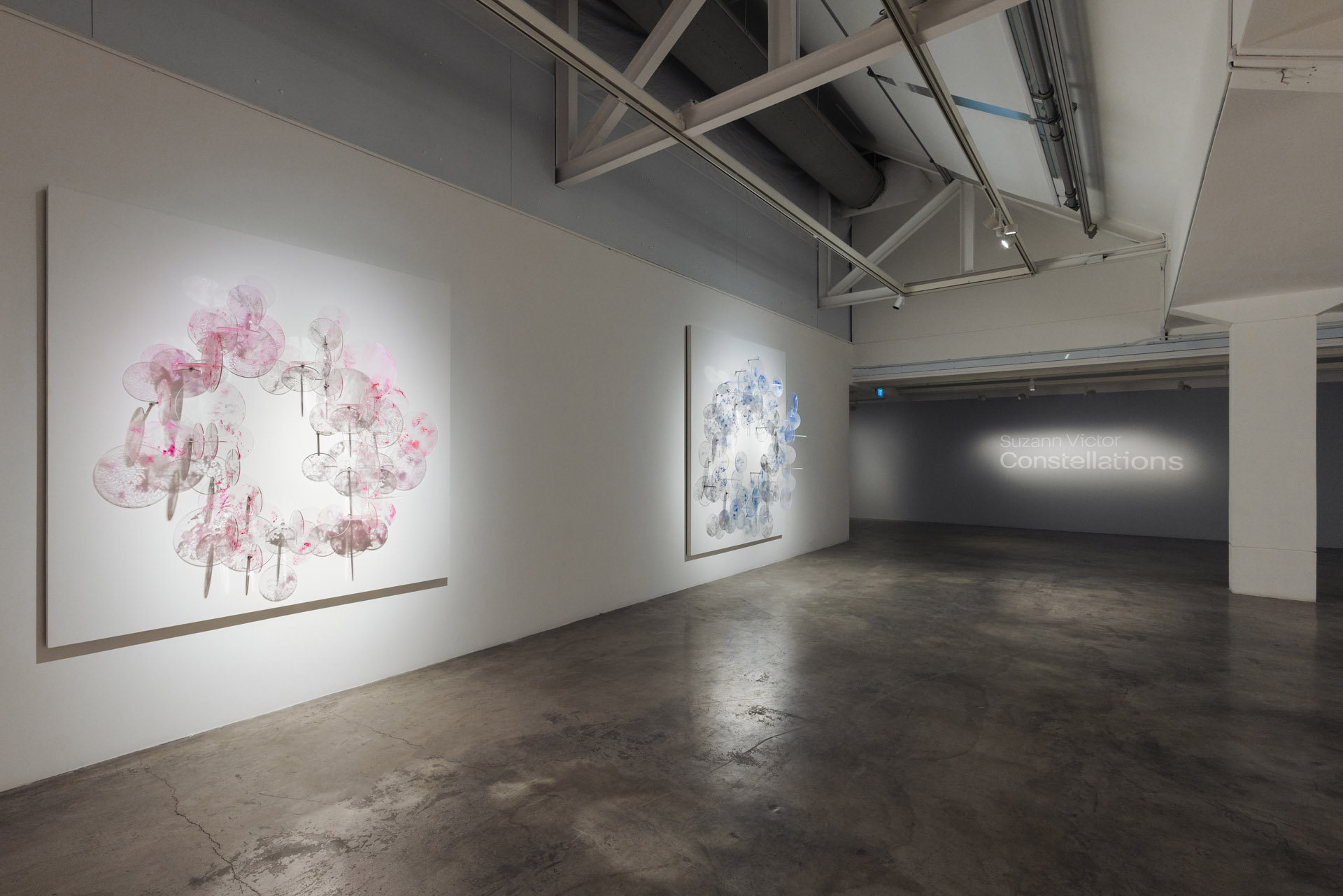
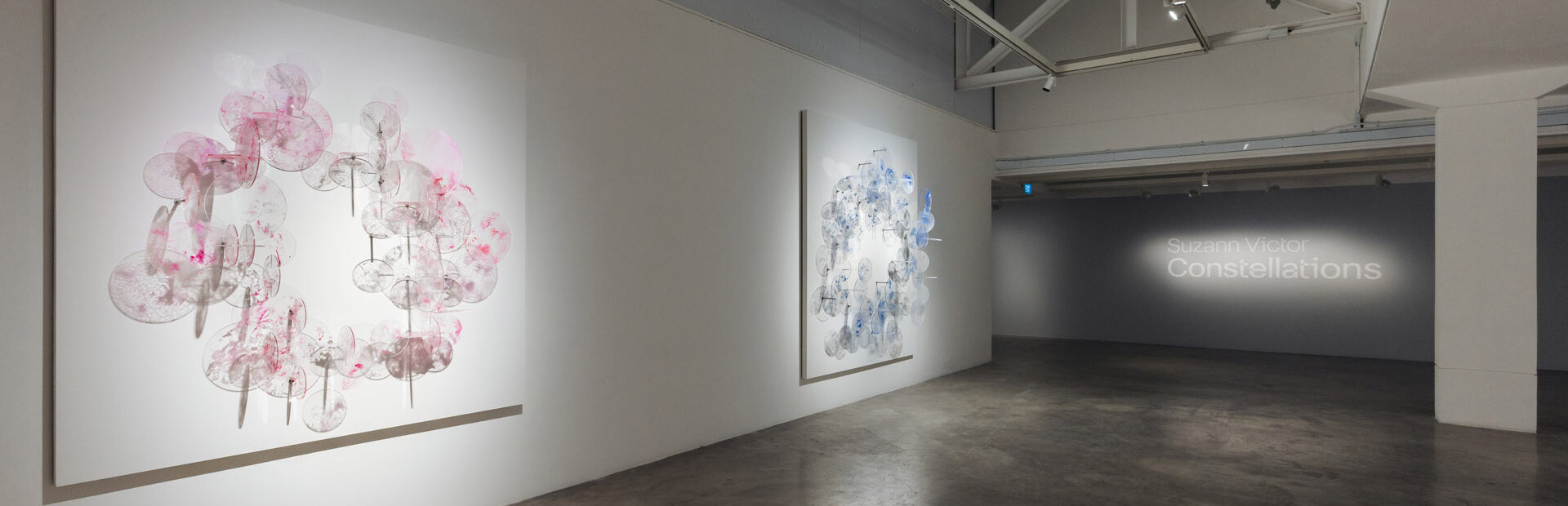
In her second residency exhibition at STPI in Singapore, Victor explored themes of transparency and shadows while experimenting with the substance and materiality of traditional printmaking. The exhibition culminated in a solo exhibition titled ‘Constellations’, now on at STPI.
Your solo exhibition ‘Constellations’ at STPI challenges traditional notions of printmaking and explores themes of transparency and shadows, creating secondary patterns on the walls. Could you share your insights regarding the inspiration behind this body of work and the materials and techniques you have employed?
Ever mindful that I am unschooled in printmaking, misguidedly or otherwise, I told myself that such ignorance can only translate into creative freedom. Surely? In any case, I set out to produce print in ways not experienced or encountered before.
There is immense power in the theatre of paradox – appearances that obscure, disappearances that reveal, visible while invisible, presence in absence, the fullness of emptiness. In this sense, the idea of transparency became the key to conducting (in)visibility like no other filter in the show.
In contrast to the substance and materiality of conventional prints, the Tension-Printing series produced invisible prints on the surfaces of transparent discs instead. These start as fluid accretions that I manipulate. When dried and cured, they literally turn into lenses that discharge light. As shadows recast into light! By projecting their own likenesses on the walls, they proliferate into a horde of secondary light-prints, thus confounding the viewer as to their true location in space. More intriguing for me is that when kindled by light, each work regenerates itself to occupy dimensions beyond its mere materiality.
The invisible images are created with a clear viscous medium placed between two discs. When pressed together, a vacuum of airless tension is created. And when pulled apart with force, fractal maps emerge from between dimensions (the disc planes), literally and metaphorically, but only to translocate us from the confines of the gallery into the world of open systems that they mirror – river tributaries, lightning, cirrus clouds, trees and spider webs, to the submerged world of mycelium structures, root systems, mangroves, reefs, or the hidden pulmonary, arterial and neural networks in human, animal or other living organisms. Despite their fractal code that dictates self-similarity and symmetry, each light-print is, in fact, unique.
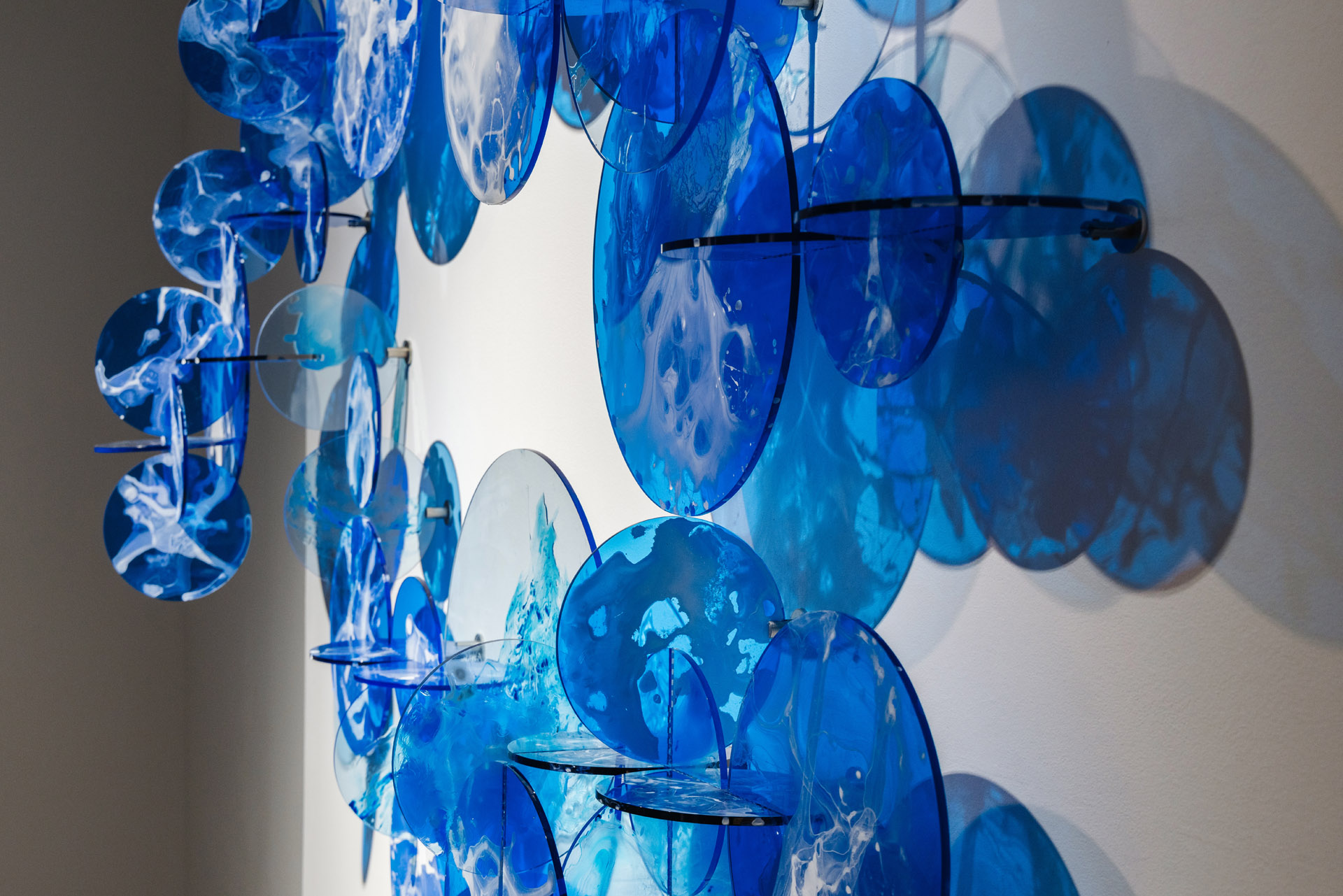
Suzann Victor, ‘Cascade’, 2025, acrylic paint and glaze medium on acrylic discs. © Suzann Victor / STPI. Image courtesy of the artist and STPI – Creative Workshop & Gallery, Singapore.
This is your second residency at STPI. How have the organisation’s unique resources – the state-of-the-art facilities and access to skilled professionals – influenced you? Additionally, how do you compare these two experiences over the ten years apart?
The state-of-the-art equipment that STPI is outfitted with, unmatched in the southern hemisphere, is incomparable to their team of master printmakers who embody the crucial human factor that informs any creative relationship between an artist and the institution. However, one may define the term “residency” as replete with undertones of solitary research and self-driven agendas; the processes at STPI are very much multi-way collaborations between the artist and the team. Highly innovative symbioses, as it turned out.
Experimentation and friendly provocations were met with unfazed energy and professionalism. The quality of attention and the way in which questions were formulated proved vitally important. I am buoyed and impressed by the creative extent to which master printmaker Oh Thiam Guan and papermaker Gordon Koh would confront the challenges that arose from these processes.
Despite the change in creative leads from Eitaro Ogawa (STPI previous master printmaker) to Guan, five new series of works requiring technical innovations came into being in both residencies that illustrate the accomplished skills and expertise of the team.
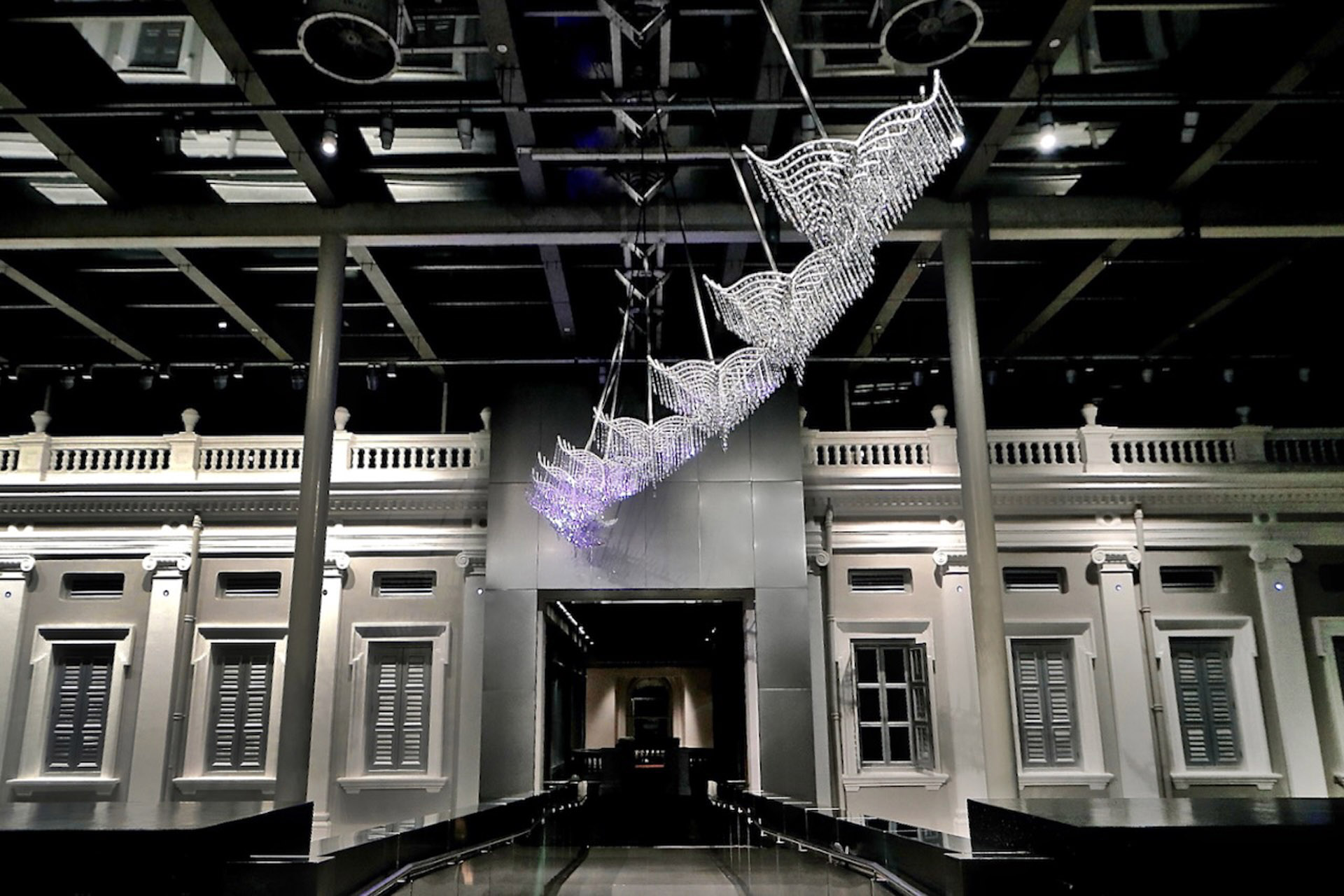
Suzann Victor, ‘Wings of a Rich Manoeuvre’, 2016, (night dragon right swing), Swarovski crystals, stainless steel, cables, LEDs, interactive kiosk. National Museum of Singapore. Image courtesy of the artist.
Throughout the years, you have employed light bulbs, acrylic lens, crystals, and even a solar charging station to produce rainbows. The interaction of light reveals itself in intricate ways, especially through the phenomena of reflection, refraction, and fragmentation. I’m intrigued to know if this emphasis on light is a deliberate and conscious choice in your artistic vision and what specific inspirations or ideas propel this exploration in your creations.
The phenomenon of light does recur in my practice, although this may have more to do with a project’s given site, context, architecture or curatorial direction rather than strictly planned. The productions come under two main areas of heliocentric works that rely on sunlight and artificial light.
I confess to a degree of artistic vanity in taking delight in listing “equatorial sunlight” as a material for ‘Rainbow Circle’ (2013), as it points to a freely available natural resource in the open sky (at least for now), and the site, Singapore, is situated on the equator.
‘Rainbow Circle’ is a meteorological installation that causes natural rainbows to appear inside the museum as a response to climate change. It seems a natural progression from the Singapore Biennale 2013’s theme ‘If the World Changed.’ Being a heliocentric work tasked with conjuring a natural phenomenon, sunlight and water were critical to its realisation. It was very exciting to merge art, science, and the latest green technology, then the heliostat, to redirect sunlight into the museum and strike falling water droplets whose refraction induced ethereal rainbows to appear.
Artificial light was used to create the sonic sculpture ‘Expense of Spirit in a Waste of Shame’ (1994), which uses everyday objects to produce a kinetic-sound work in which constellations of light bulbs continually percuss angled mirror surfaces to extract a refrain of glass-striking-glass – sounds that chime in and out of synch and harmony with the plunging motion actuated by baby rockers overhead.
Electric light bulbs were pushed further to create drawings rendered with moving light, evolving into kinetic installations in works such as ‘Wings of a Rich Manoeuvre’ (2016). Commissioned by Swarovski and Singapore’s National Museum in 2016, this work re-enacts nature’s simple harmonic sine-wave motion, showcasing twelve kinetic time-signatures as patterns drawn with light by chandelier-pendulums that swing and morph from one hypnotic pattern to the next, high above the bridge linking the Museum’s original 19th-century colonial building and its contemporary glass wing.
It is profound to learn that the human body is bioluminescent, emitting hardly discernible levels of visible light that rise and fall throughout the day, like a circadian rhythm. We are literally beings of light.
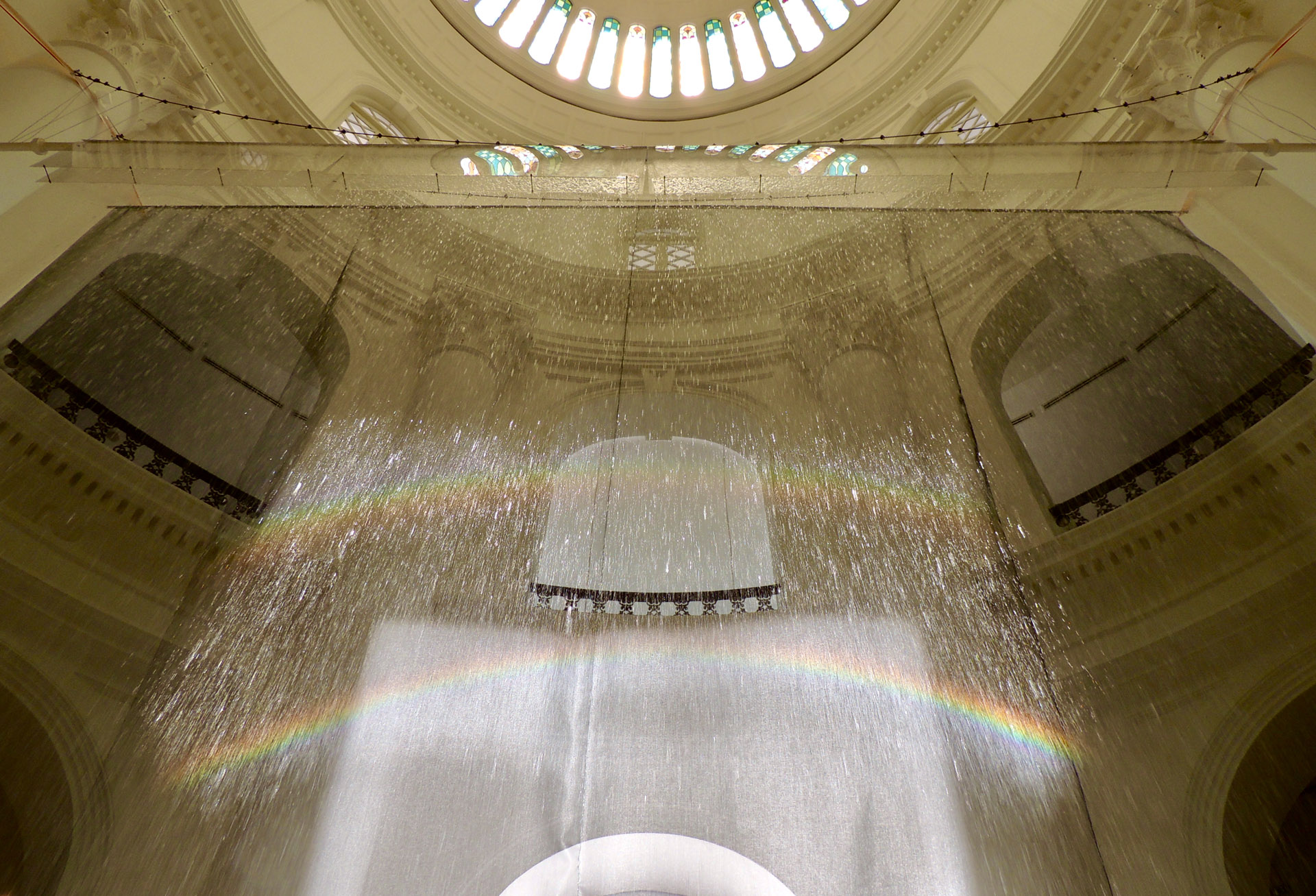
Suzann Victor, ‘Rainbow Circle’, 2013 (double rainbows), equatorial sunlight, water, trough, heliostat (solar tracking software, mirror, weather station, pipe). Singapore Biennale 2013. Image courtesy of the artist.
In your installations, viewers encounter a variety of sensory stimuli and are encouraged to take an active role in the experience. How do you envision viewers interacting with your work, and what do you hope they will gain from that interaction? Furthermore, how has this interaction evolved with the widespread use of smartphones?
If we are indeed divided, separated and disconnected from each other by our skin colour, gender, beliefs, values, commitments and convictions, perhaps one of the last frontiers of commonality and connection to each other lies in the shared phenomenological agency and experience of our bodies, and through our bodies, in an increasingly surveyed, alienating and isolating world. Our ultimate disembodied existence in an alarmingly digitised world compels me to emphasise an embodied experience of art and in art. The privileging of the primacy of sight over other forms of bodily or sensory agency can be mitigated without diminishing aesthetic pleasure or conceptual rigour.
Perhaps it might be helpful to reference ‘Rainbow Circle (2013)’ in greater detail because the viewer is generating their own perception of rainbows, relying on where the viewer placed himself or herself in terms of the angle of observation, and hence, very much an embodied experience. I regard this work as an objectless art since it responds to escalating climate change by causing actual rainbows to appear inside the museum instead of the open skies where they naturally occur. This was achieved by tracking and redirecting outdoor sunlight to be recast onto a screen of falling water droplets inside the rotunda, allowing for refraction to take place.
The rainbows in this indoor work, as with those that appear in the landscape, are in fact optical illusions generated by the viewer’s eye as they stand at a precise angle to face the sunlight striking water droplets.
The harvested solar energy also powered Singapore’s first pair of Solar-Charging Stations where the public could sit to charge their smart devices while seated to rest. These Solar Stations became a forerunner in providing electricity on-the-go for Singapore’s increasingly digitised world. Two years later in 2015, charging stations would become commonplace in MRT stations, and in 2018, charging terminals were even installed in public buses plying certain routes in the city-state. Ironically, before the work’s unveiling at the 2013 Biennale launch, a public member was fined for using a power socket in an MRT station to charge a mobile device.
From water droplets, let’s turn to the dynamic, shape-shifting nature of the Tension-Printing series in this exhibition at STPI. I say this in the sense that viewers are invited to co-author the work by manipulating a light source, such as a torch, to cause a dissolution of the work’s boundaries as well as the secondary light-prints on the wall, but only to generate fresh prints, and hence, create the artwork anew. The originally presented work simply returns into view when the viewer’s intervention is over. The idea is to offer an experience of printmaking that defies not only conventional modes of printmaking as an artist or the experience of print as a viewer but importantly, the viewer’s remaking of secondary light-prints in situ.
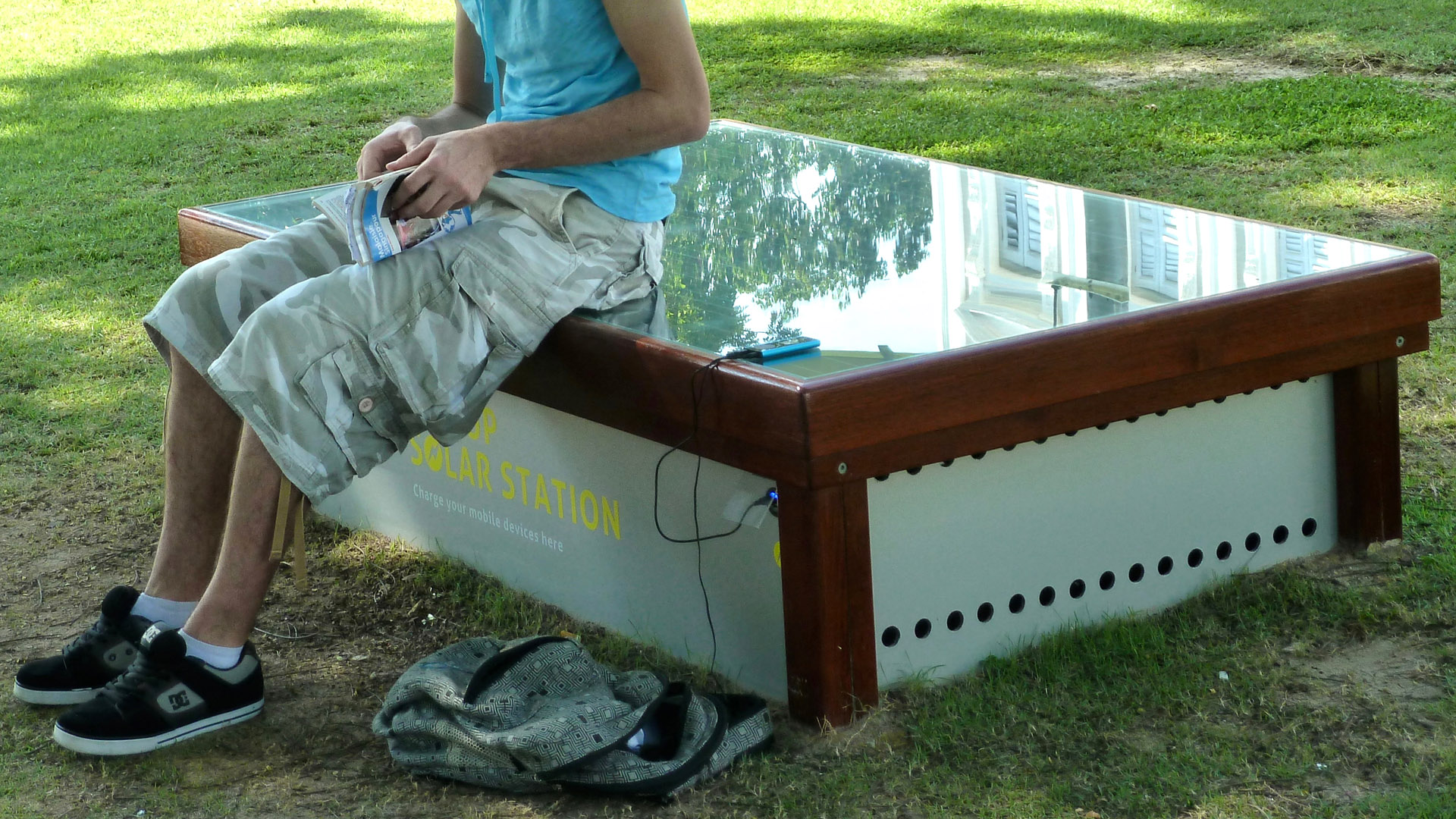
Suzann Victor, ‘Rainbow Circle’, 2013 (charging benches). Singapore Biennale 2013. Image courtesy of the artist.
You became the first female artist to represent Singapore at the Venice Biennale in 2001. It took another two decades for a female artist, Shubigi Rao, to be selected again in 2023. How do you perceive the role and place of female artists in contemporary art in Singapore and the region?
When the voices of women artists are starkly muted to the extent of two decades, as you have described, it cannot help but show a systemic inequity. However, for context, it took the 59th edition of the Venice Biennale (2022) to present a female-dominated central exhibition led by artistic director Cecilia Alemani. Even so, the New York Times reports the comments of Sonia Boyce, the United Kingdom’s first black female representative, where she reflected on how revealing the term “first” is, while the role of “representative” conjures “not a question of individual merits, but of representative merits.”
I see art as a visual form of generating knowledge and making meaning for individuals or groups to share, increase, and disseminate, including beyond immediate communities and societies. With this in mind, Miranda Fricker’s landmark study of epistemic injustice might shed some light on this conundrum as it refers to how some individuals (or groups) are denied opportunities to participate or contribute equitably to the production, transmission and exchange of ideas, information, and analyses because their experience, knowledge and efforts face a persistent culture of structural bias and undermining.
The work of women artists is immeasurably vital, intrinsic and critical to the understanding and transformation of societies and nations. It may not be in my lifetime when being a woman will no longer be such an unrelenting impediment but a reason for unbridled triumph over centuries of discrimination.
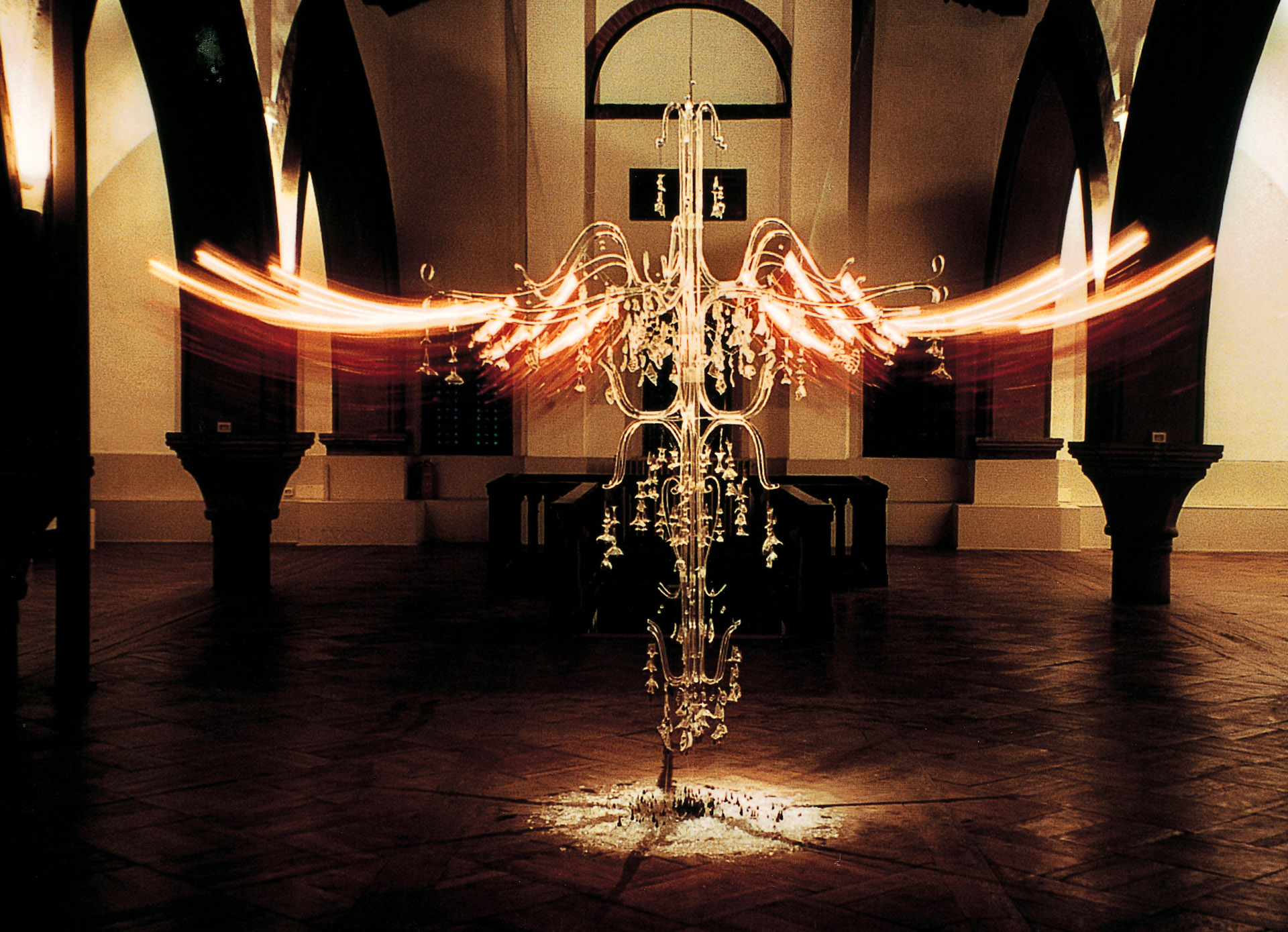
Suzann Victor, ‘Dusted by Rich Manoeuvre’, 2001, wind-shield wiper motors, acrylic rods, broken glass, pyrex glass. Singapore Pavilion at the 49th Venice Biennale. Image courtesy of the artist.
Although you have lived in Australia for nearly three decades, your practice still resonates with rich Southeast Asian influences. How has this external perspective shaped your understanding and interpretation of Singapore’s diverse historical narratives? Do you find that living abroad has given you unique insights into the cultural and historical nuances that may be overlooked by those immersed in the local context?
Living between two centres is a paradoxical condition. I become an insider nowhere and an outsider everywhere. Located, yet displaced. And so, identity becomes a state of multiple belongings. Steeped in simultaneous realities. This includes being an ethnic minority in Australia, which has taught me first-hand the disturbing predicament of being invisible, unseen and unheard. Marginalisation is no longer a contemplated condition, an imagined or intellectualised idea held from afar. While it is a visceral experience, it has also become a gift of insight into my involuntary complicity as part of a dominant group in other contexts. Such a sense of expanded identity required a special kind of navigation, a peripheral vision, or the “external perspective” you speak of, where one beholds the all-knowing centre from the margins, only to learn that this centre, by its very nature, holds a blind spot.
Suzann Victor’s solo exhibition ‘Constellations’ is on at STPI Creative Workshop & Gallery in Singapore until 2 March 2025. For more information, please click here.
FEATURE STORY COURTESY OF ALESSANDRA DIAS AND SUZANN VICTOR, FEBRUARY 2025